
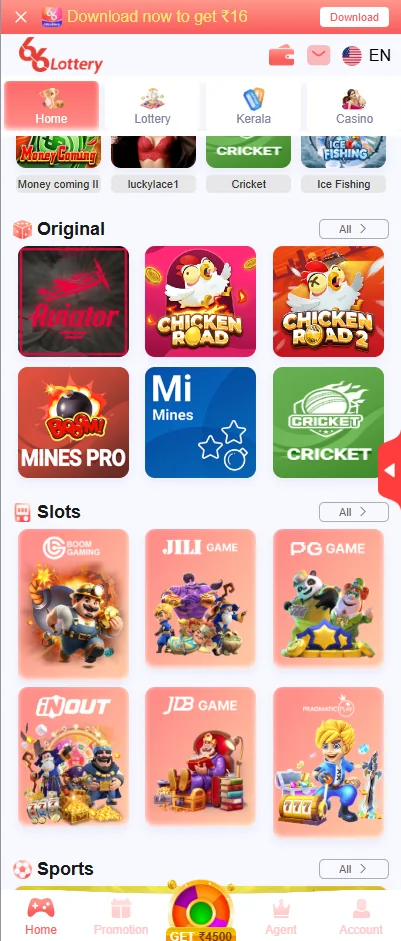
66 Lottery Game, Wingo, K3, 5D, Racing and lottery lobby
The home screen begins with broad category cards and then displays a second row of game families. Popular, Lottery, Slots and Kerala appear as large cards, while Casino, Rummy, Original, Fishing and Sports are available in the surrounding menu.
The layout is designed for quick switching. That convenience can also make similar titles easy to confuse. Read the text under the game tile and confirm the category before opening it.
The bottom navigation includes Home, Promotion, Agent and Account around a central game control. Home returns to the lobby; Account is where wallet and profile options normally appear.
For the broader 66 Lottery overview and the other account sections, return to the 66 Lottery homepage after finishing this 66 lottery games topic.
Wingo and timed colour-number rounds
The supplied Wingo screen shows duration tabs for 30 seconds, 1 minute, 3 minutes, 5 minutes and 10 minutes. Each tab represents its own period sequence and countdown.
Inside a round, the interface displays colour choices, numbered balls from 0 to 9, multiplier controls and Big or Small options. These are separate selection types, not interchangeable labels.
Game history, Chart and My history appear below the selection area. Use the active duration and period number when reading those records so results from different timers are not mixed.
K3, 5D and Racing
K3, Racing and 5D are shown beside Win Go in the lottery section. The screenshot confirms their presence but does not establish identical rules for each title.
Open the selected game’s rules or play explanation before using the wallet. Dice-style, digit-based and racing interfaces can calculate results differently even when they share the same lobby.
A recent sequence on the history screen does not make the next result predictable. Treat every round according to its displayed rules and duration.
Slots and casino categories
The game hub includes separate Slots and Casino areas. Tiles can be arranged by provider or popularity, and the same title may appear in a highlighted or recent section.
Before opening a slot or casino game, check the title and any visible provider label. Similar artwork can belong to different games with different controls.
Return to the lobby if the game opens in an unfamiliar interface or requests details that do not belong in a normal game screen.
Fishing, rummy, sports and quick-play titles
A supplied category image shows fishing titles, rummy entries and Kerala lottery cards. The lobby also includes sports and fast arcade-style games.
These categories do not share one common rule set. Fishing games may use real-time controls, rummy involves card rules, and sports sections can depend on scheduled events.
Choose the category first, then read the title-specific instructions. Avoid assuming that a wallet action or result format from one section applies to another.
Using limits in quick-result games
Timed rounds can encourage repeated decisions because a new period starts quickly. Decide a maximum session time and spending amount before opening the first round.
Do not raise the amount simply because the previous result was a loss. A longer sequence of play does not create a right to recover earlier funds.
Use the history screen as a record of completed results, not as a promise about the next period. Stop when the planned limit is reached.
Reading result history without overinterpreting it
History tables can help confirm which period completed and what result was recorded. They are useful for checking records, not for turning a chance-based sequence into a certain forecast.
A row of similar colours or numbers can occur without creating a rule for the next round. Decisions should remain within a pre-set limit rather than growing in response to the previous result.
Checking rules before switching categories
Moving from Wingo to K3, 5D, Racing, slots or fishing changes the controls and result logic. Open the title-specific rules every time a new category is selected.
Do not rely on a multiplier or button colour from another game. Even when the wallet is shared, the game screen can calculate entries and outcomes differently.
Keeping wallet use separate from game selection
The lobby is for choosing a title; the wallet area is for balance and transaction information. Avoid rushing from a deposit screen directly into a timed round without confirming the updated available balance.
A clear routine is to check the account, choose the category, read the active period and then decide whether the planned limit still fits. This reduces accidental entries and confusion between similar tiles.
Using category filters and provider sections
The game hub can group titles by category, provider, popularity or recent activity. A filter changes what is displayed; it does not change the rules of the selected game.
Return to the category label when the lobby becomes crowded. Selecting by title is more reliable than selecting only by artwork.
Checking the active Wingo period
The Wingo screen displays a period number beside the timer. Confirm that the period remains the same while making a selection and that the countdown has not reached the closing stage.
After a round completes, use history to match the recorded result with the period. Do not assume that a delayed screen still belongs to the previous timer.
Planning a session before opening the first game
Choose the category, time limit and maximum spend before using the wallet. A written limit is easier to follow than a decision made after several fast rounds.
Leave the game screen when the limit is reached. Changing to another category does not reset the amount already spent during the session.
Confirm the game, period and rule set before an action
Lobby categories can place several quick-result games beside one another. Before confirming an amount, check the game name, active period or round, countdown and selected option.
Wingo, K3, 5D, Racing, MotoRace, TRX Win and provider games do not share one universal rule set. Open the rules for the specific category instead of carrying an assumption from another game.
If the countdown reaches zero while the screen is reconnecting, wait for the result or history record rather than pressing the action again.
Use history as a record, not a prediction tool
A history screen can verify that a completed period displayed a particular result. It cannot establish that the next colour, number or sequence will repeat.
Short runs and visual patterns are easy to overinterpret in quick-result games. A fixed money limit should not be increased because a past sequence appears meaningful.
Record the period number when checking a disputed result. A screenshot without the game name or period can be difficult to match with the correct round.
Keep one session limit across the complete lobby
Switching from lottery to slots, casino, fishing, rummy or another category does not create a new budget. Use one limit for the entire account session.
Take a break when speed, losses or repeated prompts begin to influence decisions. Do not use borrowing, essential expenses or money reserved for another purpose.
After the session, compare the account history and balance rather than relying on memory. This provides a clearer record of total activity across categories.